Reflecting on Coastal Futures 2026
Back in January, I attended the Coastal Futures conference in London, one of the UK’s key gatherings for anyone working in marine conservation, coastal management, and ocean policy. It’s always a packed programme, but this year a few themes stood out that feel especially relevant to the work we’re doing at PEBL.
The Weather Is Changing Everything
A thread running through almost every session was the sheer impact of increasing rainfall and storm intensity on coastal conservation. Whether speakers were presenting on seagrass restoration, native oyster recovery, salt marsh creation, or offshore renewable developments, the message was consistent: extreme weather is disrupting projects across the board.
Two examples really brought this home. At the Rhymney Great Wharf saltmarsh restoration on the Severn Estuary, sediment polders, structures made of chestnut posts and brushwood designed to trap sediment and encourage saltmarsh growth, that had been installed two to three years ago were damaged by storms and required significant repair. This is an £852,000 Welsh Government-funded project through the Nature Networks programme, with over 2km of polder structures along the foreshore. When the very infrastructure designed to restore coastal resilience is itself being battered, it tells you something about the pace of change we’re dealing with.
Meanwhile, at the Seagrass Ocean Rescue project in North Wales, storms uprooted thousands of seagrass plants that had been carefully planted by volunteers at sites along the Pen Llŷn coastline. Porthdinllaen, home to one of the largest and densest seagrass meadows in Wales, covering an area the size of 46 football pitches, serves as the donor meadow for the wider restoration effort. When volunteer groups returned, they found plants ripped out and had to re-plant fragments in the hope they would re-establish. Months of painstaking community-led work undone in a single storm event.
But Restoration Projects Are Getting Smarter
It wasn’t all bad news, though. Equally encouraging was how restoration projects are adapting and getting smarter in response to these pressures. One of the most energising parts of the conference was seeing how low-cost sensors and citizen science are being deployed to mitigate storm damage, create early warning signals, and improve site selection for future projects.
A standout example was Fylde Council’s Our Future Coast saltmarsh project in Lancashire, where the team has deployed Mini Buoys, tiny, low-cost tidal monitoring devices developed by researchers at the University of Glasgow. These small black gadgets sit on the saltmarsh and measure tidal forces, helping experts understand how the marsh affects wave energy on the sea wall. The DEFRA-funded project, part of a £150 million Flood and Coastal Resilience Innovation Programme, is using this data to trial saltmarsh restoration techniques around Granny’s Bay, with the dual aim of bolstering existing hard sea defences and restoring biodiversity.
What’s exciting is that this isn’t just about professional scientists deploying kit. The Fylde project has recruited “Saltmarsh Champions," local volunteers who help monitor habitats, test and trial restoration techniques, and engage their own communities. It’s citizen science in the truest sense: communities deploying monitoring systems themselves, generating the data they need to understand and protect their own coastline.
This kind of grassroots monitoring is something we think about a lot at PEBL. The principle of making environmental data more accessible and more affordable is at the heart of what we do, and it was inspiring to see communities leading the charge.
Marine Net Gain: From Policy to Practice
As these community initiatives and citizen science projects grow, a new pipeline is emerging to support and scale them through the Marine Net Gain (MNG) agenda and the Marine Recovery Fund. At the conference, it was clear that MNG is progressing from policy framework towards practical delivery. A poster (pictured below) gave an excellent overview of the work underway.
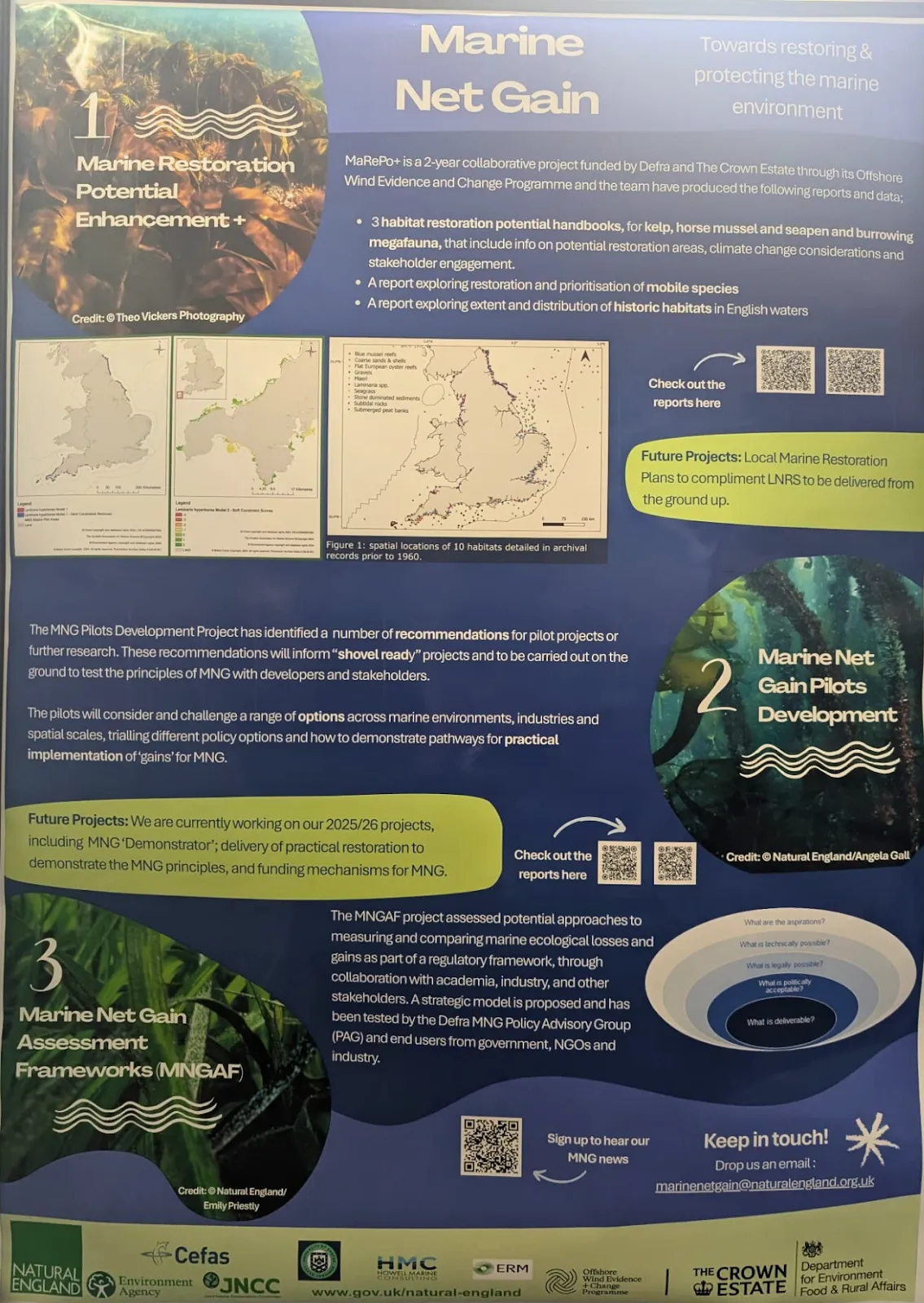
The MaRePo+ programme, a two-year collaborative project funded by Defra and The Crown Estate through the Offshore Wind Evidence and Change Programme, has produced three habitat restoration potential handbooks covering kelp, horse mussel, seapen and burrowing megafauna, alongside reports on mobile species restoration and the historic extent of habitats in English waters. This kind of baseline work is essential: you can’t restore what you don’t understand, and you can’t measure net gain without knowing what was there before.
The MNG Pilots Development programme has moved things further, identifying recommendations for “shovel ready” pilot projects that will test the principles of Marine Net Gain with developers and stakeholders across different marine environments, industries, and spatial scales. Crucially, 2025/26 projects are now underway, including an MNG “Demonstrator” and work on practical funding mechanisms for MNG.
The direction of travel here matters. Future projects include Local Marine Restoration Plans designed to complement Local Nature Recovery Strategies, built from the ground up. Combined with the Marine Recovery Fund, these developments could open up real funding for the kind of restoration work that engages communities with their local ocean. If the storm damage at Rhymney and Porthdinllaen tells us anything, it’s that restoration needs long-term monitoring and sustained funding to weather what’s coming.
The Political Paradox at the Coast
Reflecting on the conference afterwards, one thing kept turning over in my mind. Local councils are central to our flood defences and to the protection of vulnerable coastal habitats. They are frontline decision-makers, often commissioning the monitoring, trialling restoration techniques, and coordinating community responses.
And yet, in May 2025, Reform UK won 53 seats and took majority control of Lancashire County Council, the same authority area where Fylde’s saltmarsh restoration and Mini Buoy monitoring is taking place. After the election, Nigel Farage warned council workers in climate change roles to “be seeking alternative careers.”
That paradox makes the case for community engagement more urgent than ever. When the people making decisions about coastal protection don’t accept the science behind why that protection is needed, it falls to communities themselves to push for change. And that means we need activities that do three things:
-
Connect people to the coast
No one knows better than locals about the value of the places they live in. Let's collaborate to get more people out there, seeing and experiencing their shoreline first hand.
-
Empower them to do their own science
Give them the tools and knowledge to gather their own data and draw their own conclusions. This is part of our work at PEBL creating low-cost, user-friendly monitoring equipment.
-
Push the dial on council action
Armed with evidence and understanding, communities can advocate for the flood defences and habitat protections they need.