Farm Findings: The impact of shading from Seaweed Farms on seabed species may be limited by the local environment
While they are often used as models for sustainable development, the potential negative impacts of seaweed farms are regularly brought up in the world of aquaculture. One notable negative is a phenomenon known as “shading.”
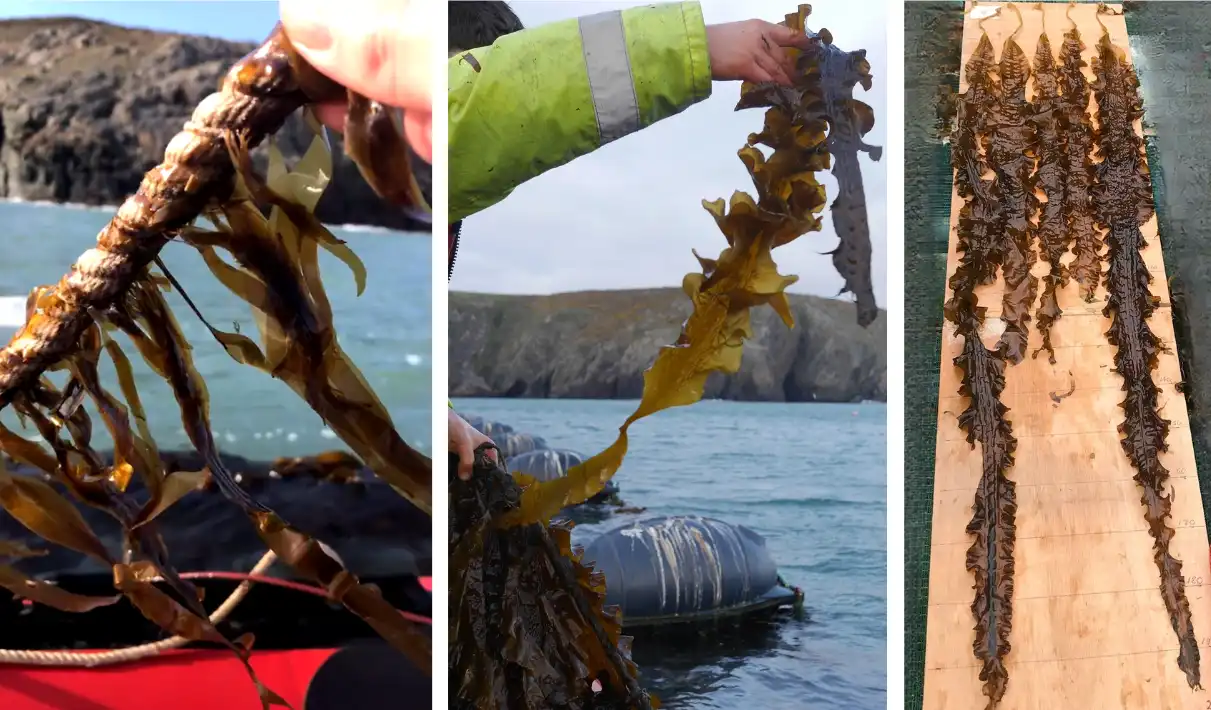
To understand shading, we first have to visualize the layout of a seaweed farm. For example, a very common setup is to use cultivation lines suspended between a network of floating buoys on the sea surface
While at first glance this seems to leave the seafloor undisturbed, a concern is raised when we think about sunlight as a limited “food” resource for certain marine organisms. By floating on the surface, is farm infrastructure and growing seaweed blocking too much light for other photosynthesisers “sun-eaters,” to thrive?
We took a two-pronged approach to investigating this question. First, we lowered an upward facing camera on the edge of Câr-y-Môr’s Carn-a-Wig farm. The camera gave us an idea of how much light filtered through the water in an area considered to be “shaded” by the farm and an un-blocked area.
We also set two long-term light sensors on the seabed to capture any changes. One below Câr-y-Môr’s St. Justinian's farm, and one at a reference location approximately 100m from the farm. The sensors ran continuously, recording the light levels for 6 months.
What we found?
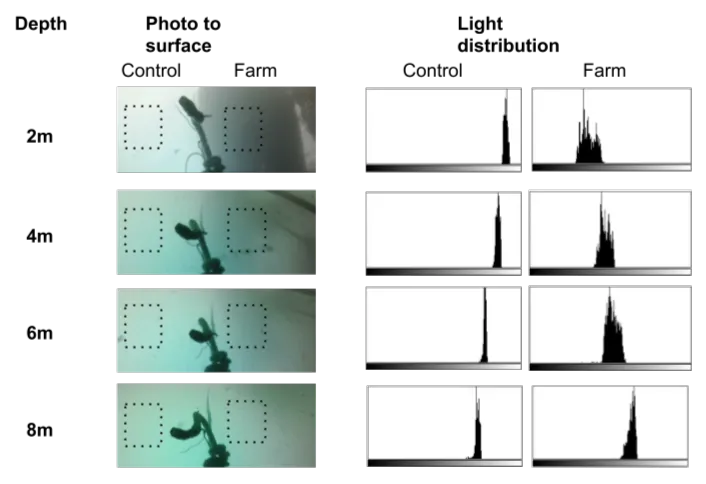
The camera drop showed us that differences in light availability between the farm site and the control were most drastic near the surface. As the camera lowered, these differences became almost imperceptible (Fig. 1).
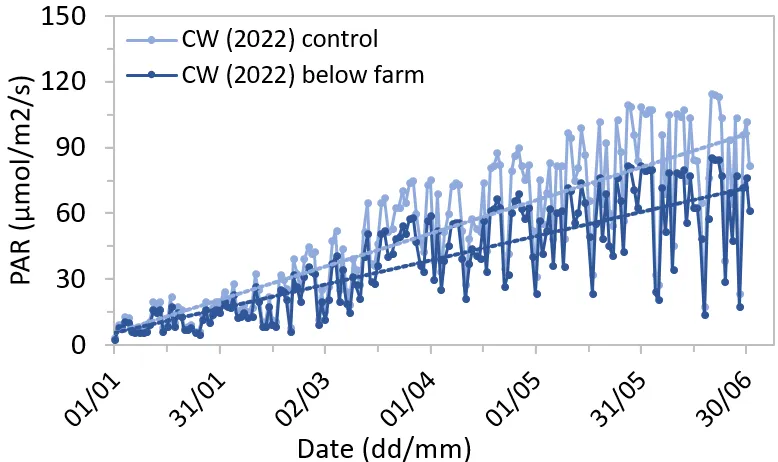
Our longer term study showed that in the winter light levels are universally very low, thus the two sensor readings are almost indistinguishable. However, in the summer there is a clear distinction between the two sensors, with the unit below the farm detecting up to ~25% less light during the month of June (Fig. 2).
What does this mean?
What we observed in the camera drop follows accepted studies which find that floating infrastructure causes greater levels of shading in shallow, clear, waters. As light filters through the water column it bounces off of suspended sediment and other particles, a process known as “diffusion.” This spreads light more evenly over the seabed. In shallow, clear water there is less space and particulate for diffusion, and thus we observe a stronger shadow.
In the past at Câr-y-Môr we have observed very high turbidity (amount of particulate in the water), which may cause increased light diffusion even at shallow depths, essentially softening the impacts of shading. This, and the relatively small scale operation at Carn a Wig may explain why we saw virtually no difference in light availability between the farm and control at 8m during the camera drop.
In the long-term study we showed that the impact of shading depends heavily on season. At peak growth in June, seaweed had grown heavily to cover the cultivation lines and blocked more sunlight. However at this stage, we only observed a decrease of 25% at 11.5m depth. Another study on seaweed farms in a similar environment observed that even with a decrease of 40% at 5m depth, there was likely little impact on other photosynthetic organisms. Furthermore, the stage of “peak growth” is time-limited, as seaweed is “thinned out” by harvesting at multiple points throughout the summer.
While we observed minimal shading at Câr-y-Môr, nevertheless, developers should be cautious when selecting areas to farm seaweed. Sensitive benthic species, such as seagrass or merle beds, may be negatively impacted even by a little decrease in light availability. To address this, Câr-y-Môr has undertaken extensive seabed habitat surveying both before and during deployment of their farms to ensure sensitive communities are identified and avoided.
The long-term effects of seaweed farm shading on seabed ecosystems need further investigation, especially in areas with clearer water and denser farm layouts (multiple closely spaced lines) over several growing seasons. This will provide a clearer picture of the impact on light-dependent species in less turbid environments where shading might be more significant compared to this Welsh coast example.
References
- Native Aquatic Vegetation Survey Protocol: Siting Seaweed Farms, Washington State Department of Natural Resources
- Visch, W., Kononets, M., Hall, P.O.J., Nylund, G.M., Pavia, H., 2020. Environmental impact of kelp (Saccharina latissima) aquaculture. Marine Pollution Bulletin 155, 110962. https://doi.org/10.1016/j.marpolbul.2020.110962
- (unpublished) Berger, C., Papazova, P., Marshall, B., Evans, F., Williams, C., 2024. Integrating environmental and ecological monitoring with seaweed farming. https://doi.org/10.1101/2024.02.15.580450